Skip to content Skip to cookie consent
Tearfund home
Donate

Ebola: meet three of the people preventing the spread

Tearfund and our partners in the DRC are doing vital work to help communities stay safe from Ebola. More help is needed.

Written by Tarryn Pegna | 03 Jul 2026

Two people load a green Tearfund barrel into an SUV, outside a thatched hut under blue sky.

Tearfund is helping raise awareness of how to prevent the spread of Ebola and providing things like handwashing stations, soap and chlorine. Credit: Elijah Muweza/Tearfund

An outbreak of Ebola virus disease was officially declared in the Democratic Republic of Congo (DRC) on 15 May.

The latest outbreak is largely centred in Ituri. It’s a remote and densely populated area and these characteristics, along with high levels of insecurity in the country, growing humanitarian need and lots of movement in the population, all worsen the danger of the virus spreading.

This particular strain, too, is causing increased concern. Known as the Bundibugyo species of Ebola, there is currently no vaccine or specific treatment for it.

More than 1,900 cases, 700 deaths, 213 recoveries

As at 8 July 2026, the DRC’s National Institute of Public Health statistics showed more than 1,900 confirmed cases and 700 related deaths. I

By 3 July, 213 people who tested positive for the virus had recovered.

The World Health Organisation states: ‘Community engagement will be key. It is only when communities are engaged in the response that such outbreaks are brought under control.’

Tearfund and our local partners in the DRC are working to help make this happen.
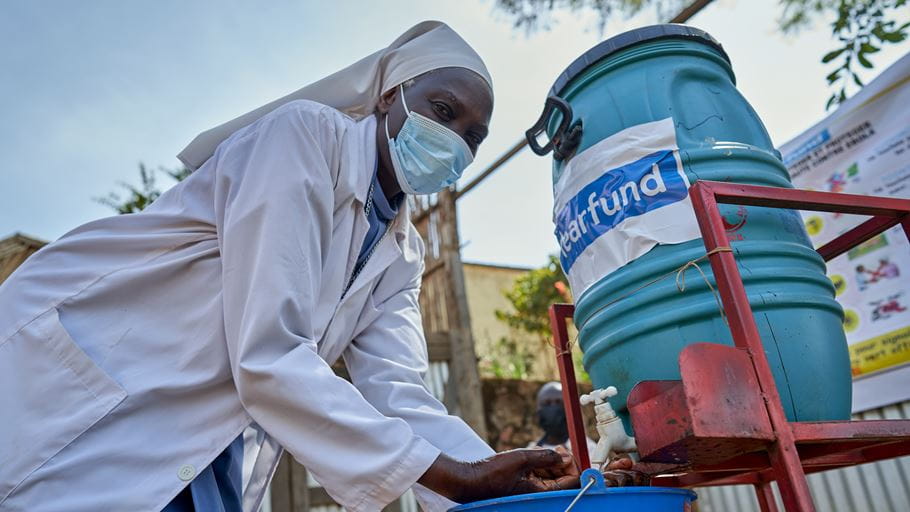
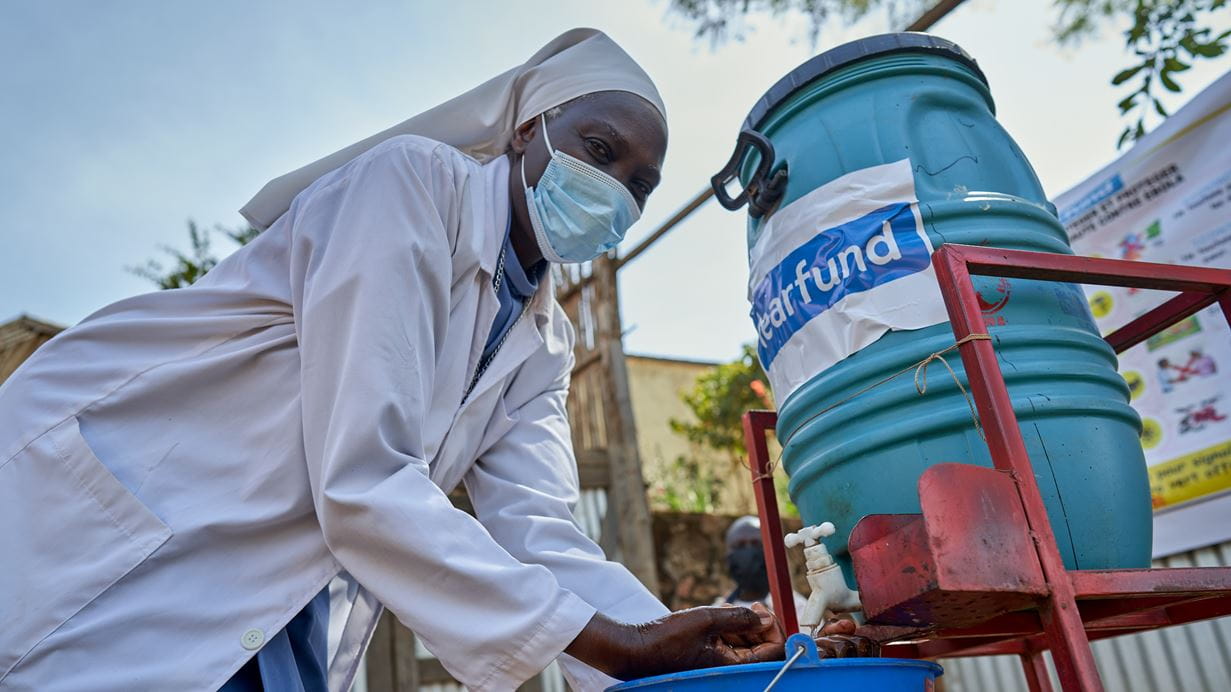
Woman in mask and lab coat washing hands at an outdoor handwashing station with a blue barrel.

Sister Henriette washes her hands at a Tearfund-supplied handwashing station. Credit: Elijah Muweza/Tearfund

Sister Henriette: Nurse-in-Charge

Sister Henriette Buve is the Nurse-in-Charge of an antenatal health centre in the DRC which has received support from Tearfund. She explains some of the challenges they are facing in working to protect the community from Ebola:

‘What makes our work difficult is that, up to now, many people still do not really believe in this disease.

‘They do not fully believe that the disease is present here. However, as they hear reports from different places, they are beginning to understand.

‘But we don’t have enough personal protective equipment. We lack protective materials and preventive supplies, including handwashing facilities and hygiene materials.

‘If we had enough supplies, we would not be so afraid.’
Sister Henriette, Nurse-in-Charge

‘As healthcare workers, we urgently need more equipment.

‘If we had enough supplies, we would not be so afraid.’

The disease is frightening. And not having access to basic requirements, such as enough clean water, makes combating the spread even more difficult, especially since regular handwashing is the simplest, most vital way to help stop the virus being transmitted.

And that’s an important message that people like Sister Henriette and community volunteers are trying to make sure people get to hear and understand.

‘The people who can help us most to prevent the spread of this disease,’ she says, ‘are the community health volunteers, who serve as a bridge between health facilities and the wider community.

‘These are the people who are most important to us.’

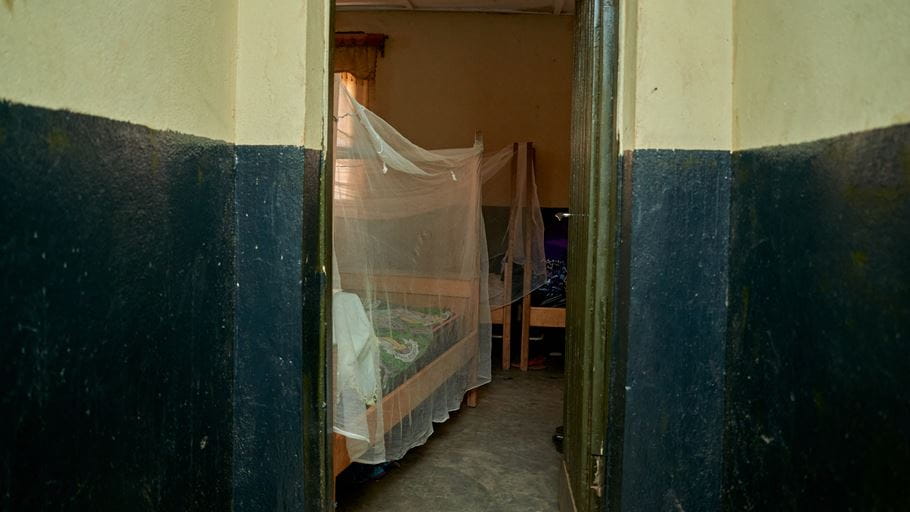
View through a doorway into a simple healthcare centre with a wooden bed covered by a mosquito net.

The antenatal healthcare centre where Sister Henriette is Nurse-in-Charge. Credit: Elijah Muweza/Tearfund

Basic preventive measures: water, chlorine, soap… but no gloves

‘We have put in place basic preventive measures. We have placed water points in front of each service area, and within every service, we provide soap for handwashing at all times. After touching a patient, health workers must wash their hands immediately.

‘Ideally, every patient entering the facility should wash their hands before receiving care.

‘Tearfund supports us with chlorine, disinfectants and liquid soap. However, some essential supplies are still lacking.

‘For example, when caring for patients, we should be using gloves. But we still don’t have enough gloves, which would help prevent transmission.’

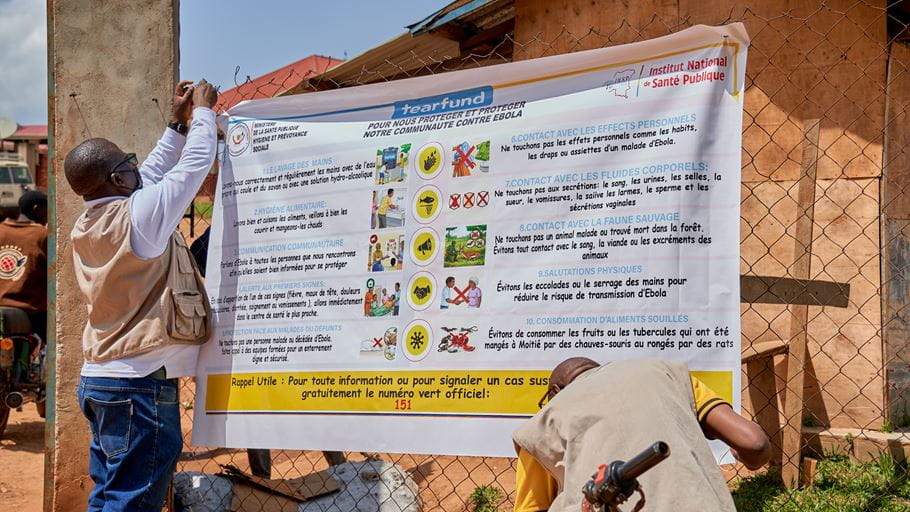
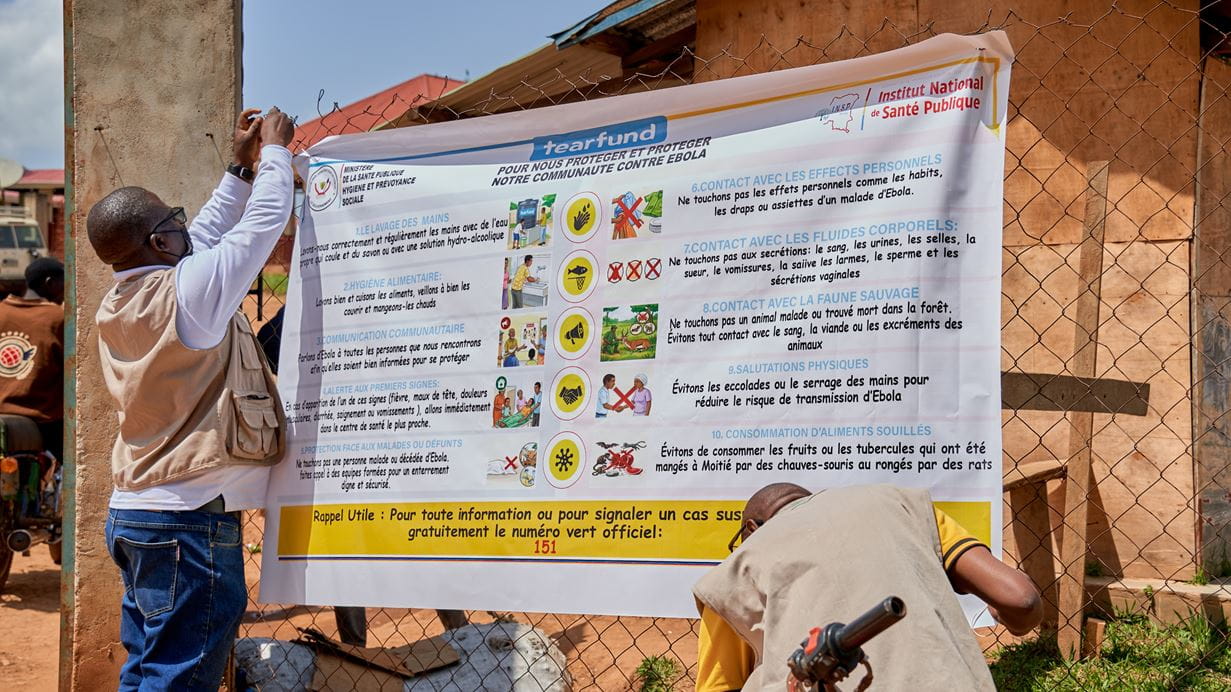
Two men hang a large French banner detailing Ebola prevention measures outdoors.

Tearfund staff member, Aimé, sets up a poster showing vital information about how to stay safe from the virus. Credit: Elijah Muweza/Tearfund

Aimé Mahano, responding to Ebola with Tearfund 

Aimé Mahano is one of Tearfund’s Field Project Managers in Ituri Province. He explains Tearfund’s support of places like Sister Henriette’s health centre:

‘It’s important for us to act quickly in response to this disease, because first and foremost, this disease kills.

‘At present, there is no specific treatment and no vaccine available locally. And it poses a serious public health threat.

‘That’s why Tearfund is taking immediate action to help contain this disease.

‘Firstly, Tearfund is raising awareness in the communities about the importance of handwashing as a key preventative measure. We are also installing handwashing facilities at places like markets, taxi parks, stadiums, churches and schools.

‘Tearfund is also supplying chlorine to health facilities, primarily for handwashing at the entrance of each facility, as well as for disinfecting floors, latrines and other surfaces, including walls and high-contact surfaces within health facilities.’

‘We’re also training people in the affected communities to be mobilisers and opinion leaders so they can help people understand how to prevent Ebola and know what to do to comply with safety measures put in place to stop the virus spreading.

‘These opinion leaders are also talking about vital things like burials.

‘Many people here still do not fully understand that the disease is real, and when a death occurs, community members often act out of compassion and family solidarity to bury the deceased  – but this is often without following safe procedures, and this remains a major challenge.’

‘It’s important for us to act quickly in response to this disease, because first and foremost, this disease kills.’
Aimé Mahano

Water: the answer and the issue

‘One of the main challenges we’re facing in this response is access to water,’ says Aimé. ‘To obtain water, community members often have to travel long distances, yet water is essential for handwashing. Ensuring an adequate water supply, particularly for the 135-litre handwashing stations Tearfund has been deploying in communities, remains a major challenge.’

Busy settings, increased risk, growing understanding

‘Another thing that can help prevent the spread of Ebola is to maintain social distance in busy settings, such as markets, churches and health centres.

‘Tearfund is working with communities and church leaders to promote behaviour that will keep people safe from the disease, however, physical distancing is still not consistently observed in churches, which makes them another high-risk setting.

‘Hospitals are also exposed to risk. Particularly because many health facilities still lack the essential resources needed to effectively respond to the outbreak.

‘Another challenge is that many people still do not understand the importance of handwashing.

‘People are watching the situation unfold, but many still do not fully understand that the disease is real.

‘Also, there are areas where we are working, and other areas where no intervention is currently taking place [because of lack of resources]. In some locations, there are no organisations supporting the community. As a result, people move between communities where there is no intervention and communities where interventions are taking place. This population movement increases the risk of transmission – potentially bringing infection into areas that remain unaffected.

‘This is a challenge that we continue to highlight within communities.’

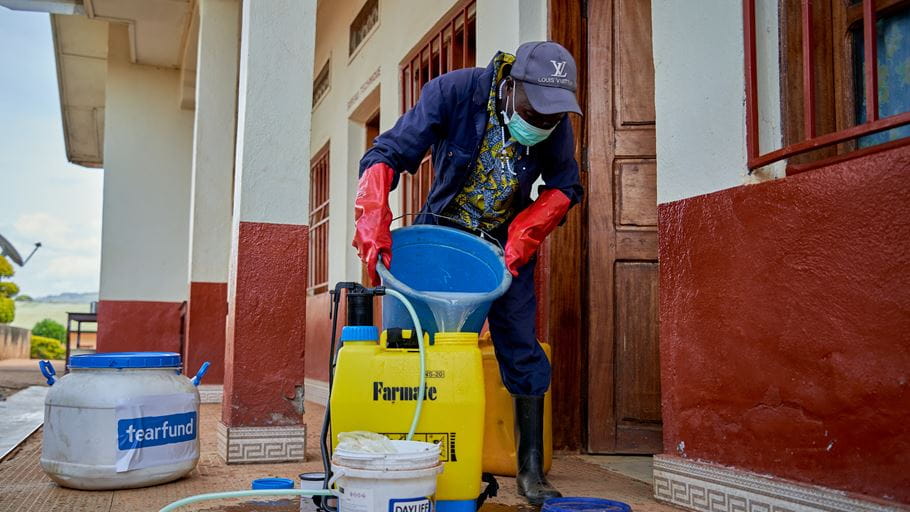
Person in PPE pouring liquid into a sprayer on a porch, preparing for disinfection.

Ucune Bibwinyo is a hygiene officer at a local hospital. His job is to make sure walls and surfaces are disinfected and that handwashing stations are available for use. Credit: Elijah Muweza/Tearfund

Ucune Bibwinyo: disinfecting for safety

Ucune Bibwinyo is a hygiene officer at a local hospital. His job is to make sure walls and surfaces are disinfected and that handwashing stations are available for use.

He says, ‘We heard that Ebola had reached Bunia and Mungwalu. Now, there are people here at the hospital in isolation, and some of them have also died.

‘I protect myself by maintaining good hygiene in my household and encouraging my family to wash their hands regularly. I wash my hands when I arrive at work, when I return home, and even before eating.

‘In the community, some people believe that Ebola exists, while others do not. My job is to encourage them to protect themselves.

‘I’ve been instructed to carry out disinfection activities very frequently because both contact cases and infected patients come to this facility.

‘We need to pray that this outbreak comes to an end soon; otherwise, many people may lose their lives.’

Read more here about what Tearfund has been doing to help prevent the spread of Ebola.

How can I make a difference?

If you would like to contribute by praying regularly with us, or giving financially, you can do so at these links:

🙏 Pray with us

🎁 Give

Pray about Ebola (points from our staff)

    • Pray for the communities affected by this outbreak. Pray that people will understand that the disease is real and that together we must fight against it.
    • Please also pray for all those implementing response activities, including Tearfund’s teams – that they may have the capacity to support communities towards positive behaviour change.
    • Pray for the needs of affected communities – they are immense and communities require urgent support.

Written by

Written by  Tarryn Pegna

Share this page

Share this page to spread the word and help support those in need.

Get our email updates

Learn about our work and stay in touch with Tearfund. Hear about our news, activities and appeals by email.

Sign up now - Get our email updates