Skip to content Skip to cookie consent
Tearfund home
Donate

The art of a sustainable business in Basrah

Mohammed’s origami story of second chances – for him, for the materials he works with, and the environment as a whole.

Written by Tarryn Pegna | 17 Jul 2025

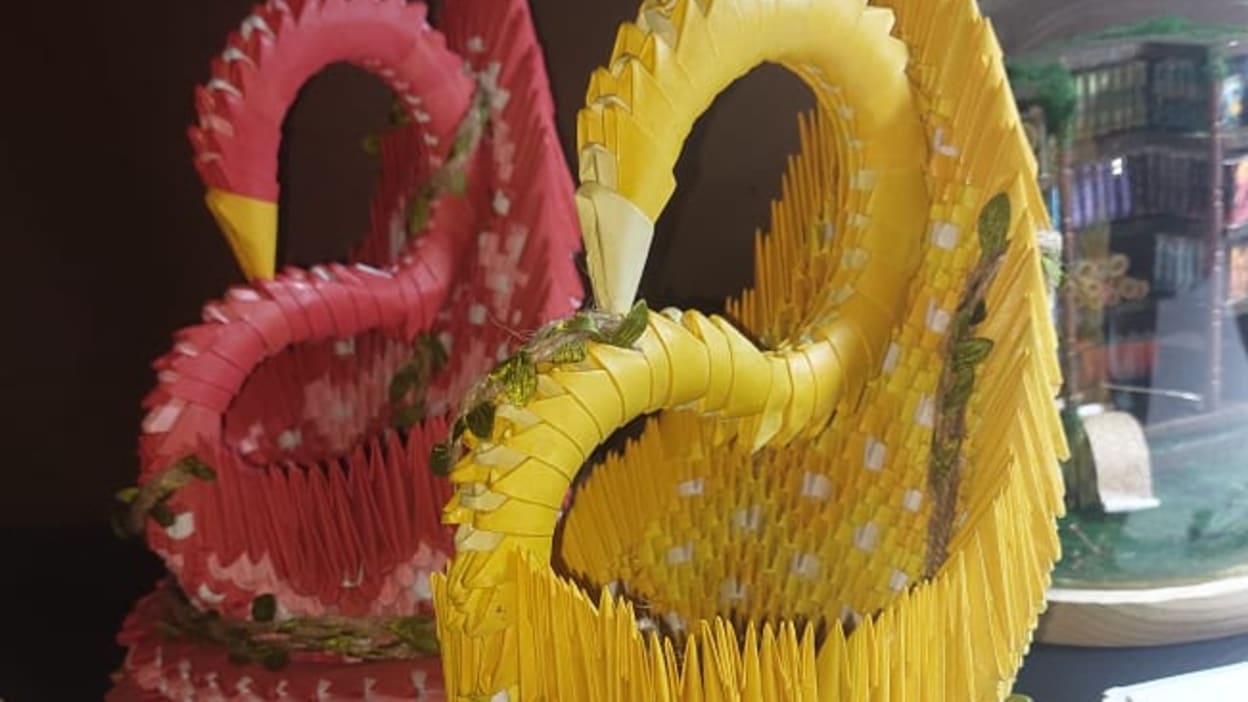
Two intricately crafted swans, made of folded pieces of paper, sit next to each other on a work surface.

Two of Mohammed’s origami creations. Almost all of his art is created using repurposed waste paper. His business is a beautiful example of circular economy principles in practice. Credit: Tearfund

Origami, the traditional Japanese art of folding paper into shapes without cutting or glueing it, has fascinated Mohammed since he first discovered it as a young boy, aged six. ‘Each folded figure tells a story,’ he explains. ‘Not just of creativity, but of second chances, for both paper and people.’

And, indeed, Mohammed’s origami story is one of second chances – for him, for the materials he works with, and even for the environment as a whole.

Iraq, climate change and searching for environmentally sustainable solutions

Iraq, where Mohammed lives, has been ranked by the UN as one of the most vulnerable countries in the world to the effects of climate change. The country is already experiencing more frequent and severe heat extremes and has struggled with drought, creating increasingly difficult conditions for millions of people, many of whom already faced socio-economic struggles.

Because of this, Tearfund supports work through a local partner in Iraq that helps people create livelihoods which will not only provide an income, but are also environmentally sustainable. And the business Mohammed has set up, making and selling his origami artworks, running workshops and taking part in community exhibitions, is a beautiful example of the good results.

But it hasn’t been easy for Mohammed to get to this point.

Academics, acceptance and a new way of doing things

Apart from financial constraints, Mohammed struggled within his family to find acceptance and support for his passion. Traditionally, his family had placed great emphasis on academic achievement and had seen particular career paths as the only appropriate choice. They dismissed his goals as a hobby, suggesting that he should study to be an engineer like his brothers, and Mohammad says he felt frustrated, isolated and discouraged because of this.

Financial constraints made it even harder for him to achieve what he hoped to, as he was unable to afford the good-quality materials he needed. This limited his ability to create, to experiment and innovate.

Still, he persevered and, over the years, his skills grew and developed as he practised his art.

Mohammed learned to craft incredibly intricate figures of flowers, animals and other decorative objects, driven by his imagination, using nothing more than simple pieces of paper.

Eventually, he began working at another job, and it was there that colleagues and mentors started to notice his talent. One mentor in particular encouraged him to exhibit his origami and to teach workshops to share his skills.

‘When I received support, it wasn’t merely financial assistance; it was a powerful affirmation that my dreams and sustainable vision were recognised and valued. That validation became the driving force behind my perseverance and creative growth.’
Mohammed, Iraq

Resources and respect

Still, despite the growing recognition he received, he continued to face a very practical challenge: his art depended on the continual use of paper – a resource which was costly and also could add to environmental waste.

However, things started to improve when Mohammed received financial assistance through Tearfund’s local partner, the Green Basrah project. Tearfund’s partner also trained Mohammad and other programme participants in circular economy principles to ensure that each business idea contributed to a greener business ecosystem. With this backing and encouragement, Mohammad was able to access the tools he needed and was also motivated to look for new, sustainable ways to practice his art.

Rather than relying on costly new supplies, he came up with the idea of collecting discarded paper from schools, print shops and office buildings nearby – paper that would otherwise end up in landfills. Then, at home, he created a simple sorting and cleaning system, readying the paper for repurposing into high-quality origami pieces.

By repurposing wastepaper for his artwork, he reduced his costs significantly, he always had plenty of paper, and he also contributed to reducing waste in his community.

With the proper resources now at his disposal, Mohammad was able to test more creative and complex ideas. His work became more sophisticated, and his creations more intricate and spectacular. He grew in confidence and the support empowered him to experiment and try new things, pushing the boundaries of what could be achieved with origami.

Successful, sustainable, satisfying

His successful, sustainable model finally gained him the local attention and respect that he longed for, allowing him to turn his passion into the socially and environmentally conscious microbusiness that he now runs.

He explains, ‘When I received support, it wasn’t merely financial assistance; it was a powerful affirmation that my dreams and sustainable vision were recognised and valued. That validation became the driving force behind my perseverance and creative growth.

‘It gave me the confidence to believe my dreams were worth pursuing. For the first time, I felt like my work had real value.

‘Now, I feel empowered to create without limits.’

Mohammed has also launched a community initiative called From Waste to Art, which offers workshops where children and young people can learn the technical skills of origami and the environmental principles behind it. Through these sessions, participants learn how to turn waste into beauty and to see discarded materials as opportunities, not burdens.

Looking ahead, Mohammed dreams of establishing a creative recycling centre where artists, educators and students can come together to explore new forms of sustainable art and find new ways to reuse resources.

An example of a circular economy: Mohammed’s origami

In a circular economy, we need to ensure that, as in nature, products are designed to re-enter the cycle in one form or another after their use – and not to become useless waste.

Mohammed’s origami business is a beautiful example of putting circular economy principles into practice.< /p>

  • Reduce: avoids the use of new or virgin paper materials.
  • Reuse: collects and repurposes discarded paper for creative use.
  • Rethink: challenges the notion of waste by turning it into beauty and income.
  • Educate: spread awareness through workshops and school programs.
  • Regenerate: inspires a cultural shift toward sustainability in his community

If you’d like to make more work like this possible, please give here.

Written by

Written by  Tarryn Pegna

Share this page

Share this page to spread the word and help support those in need.

Get our email updates

Learn about our work and stay in touch with Tearfund. Hear about our news, activities and appeals by email.

Sign up now - Get our email updates