Skip to content Skip to cookie consent
Tearfund home
Donate

Holding the line for an ambitious plastics treaty

Lucy Tanner reflects on her time at INC-5 and whether it was a step forward or backwards for people living in poverty.

Written by Lucy Tanner | 15 Jan 2025

A large group of people stand together holding a banner reading 'International alliance of waste pickers'.

The International Alliance of Waste Pickers delegation with their allies, including the Tearfund team, at INC-5 in South Korea. Credit: IISD/ENB, Kiara Worth

Held in South Korea at the end of 2024, the fifth round of plastics treaty negotiations should have been the last. Long hours of difficult negotiations partly bridged the gap between countries, but talks were suspended after delegates failed to reach an agreement.

Lucy Tanner, Tearfund’s Senior Policy Advisor on Plastics and Waste, shares her reflections on her time at the negotiations and what this means for the future…

Failing to agree a treaty on plastics is bad news for our planet and it leaves people in poverty waiting for justice.

In the seven days we were in Busan, 8.7 million tonnes of primary polymers were manufactured. Not only that, but 441,000 tonnes of plastic waste entered our rivers, lakes and oceans, and a further 1.3 million tonnes of plastic waste were incinerated.

Driven by their fossil fuel interests and supported by the large number of industry lobbyists who attended the talks, certain countries continue to obstruct the treaty process. Meanwhile, people living in poverty are suffering the devastating impacts of plastic pollution on their health and livelihoods.

But that’s not the whole story…

The power of united ambition

A large part of the reason why delegates could not reach an agreement is because ambitious countries, who are the majority, refused to settle for a weak treaty. With strong support from observers, they raised their voices, established clear red lines on what the treaty should include. Crucially, they also held the line in the face of vocal opposition from a very small number of states.
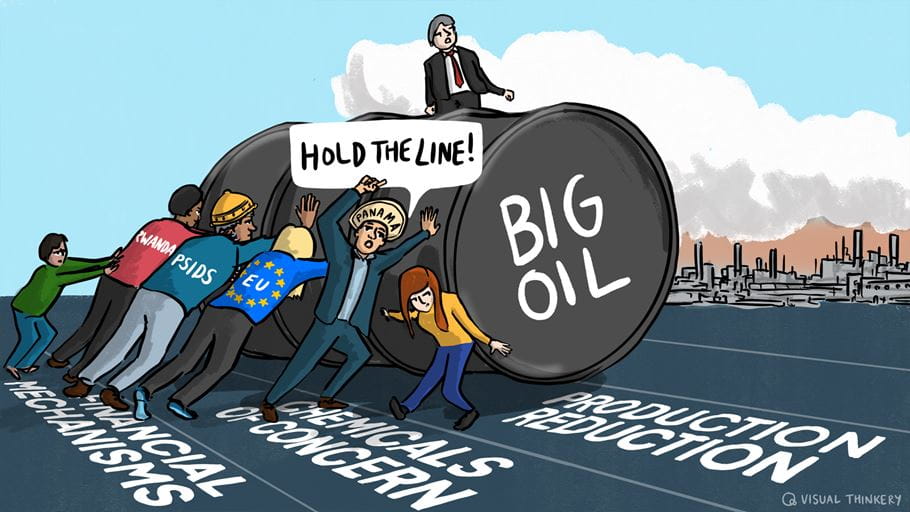
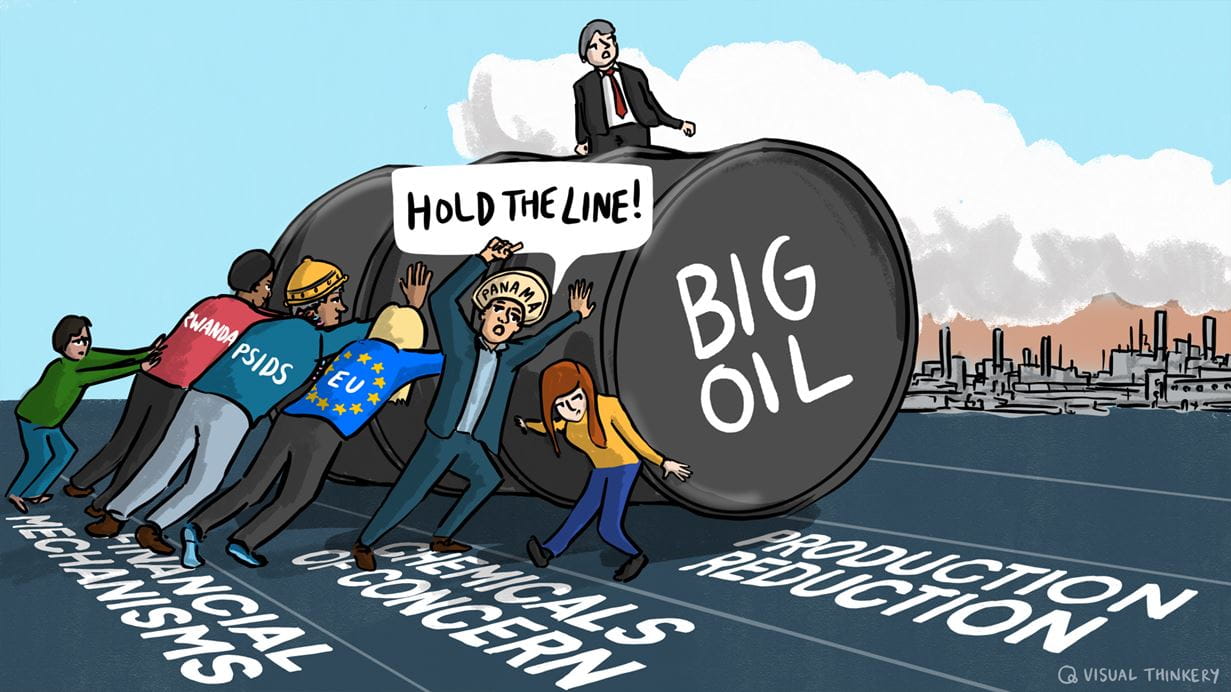
A cartoon drawing showing a man in a suit sitting on a large, rolling barrel that says 'Big Oil' that is being held back by several men and women of different nationalities.

Juan Carlos Monterrey Gomez of Panama (wearing the hat in this cartoon) delivered many impassioned statements during the week and urged us all to continue on ‘with fire in our hearts’. Credit: Break Free from Plastic/Visual Thinkery

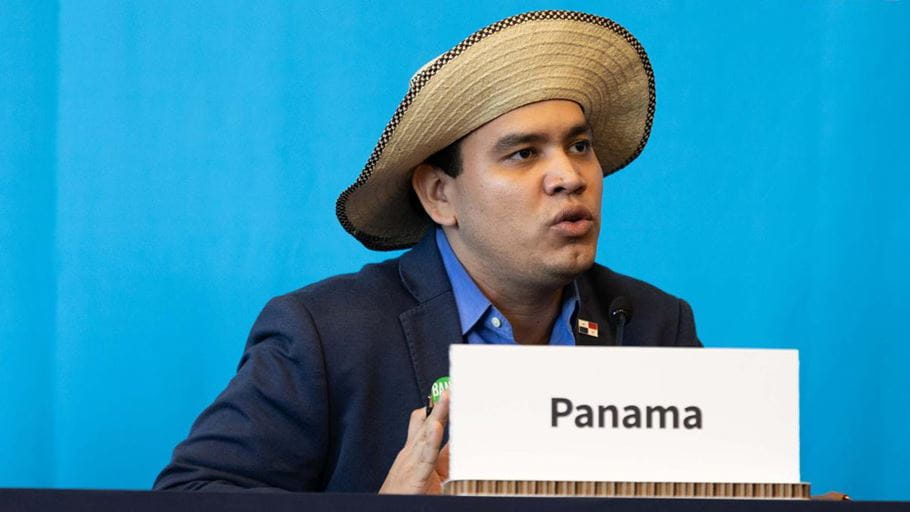
More than 100 countries, including the UK, supported text introduced by Panama calling for plastic production to be reduced to 'sustainable levels'. Juan Carlos Monterrey Gomez, the lead negotiator for Panama, was one of the stand-out figures of the week. Rarely seen without his trademark hat, he brought a unique energy and enthusiasm to the negotiations. This worked to galvanise other delegations and amplified the voices of non-governmental organisations (NGOs).

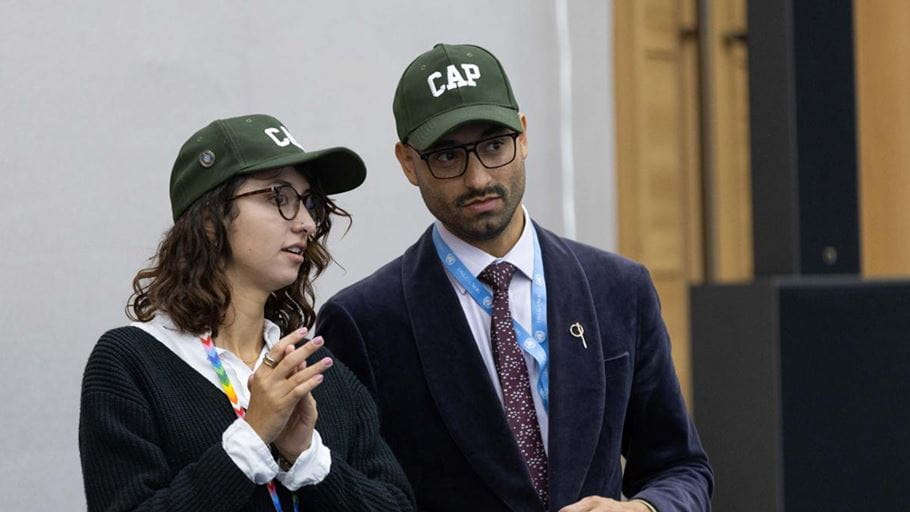
Hats seemed to be the style choice of the week. Another delegate, Camila Zepeda, of Mexico, launched a Declaration on Plastic Products and Chemicals of Concern on behalf of 94 countries in a stylish purple bucket hat. Delegates from the Centre for International Environmental Law also sported a very snazzy baseball cap punningly calling for a ‘cap’ on supply!

A man wearing a Panama hat speaks into a microphone.
A man and a woman standing in conversation wearing green baseball caps with the word ‘CAP’ on them.

Top: Juan Carlos Monterrey Gomez speaking at a press conference during INC-5. Credit: IISD/ENB, Kiara Worth Bottom: Observers from the Center for International Environmental Law (CIEL) consult. Credit: IISD/ENB,  Kiara Worth

Keeping the door open for waste pickers’ input

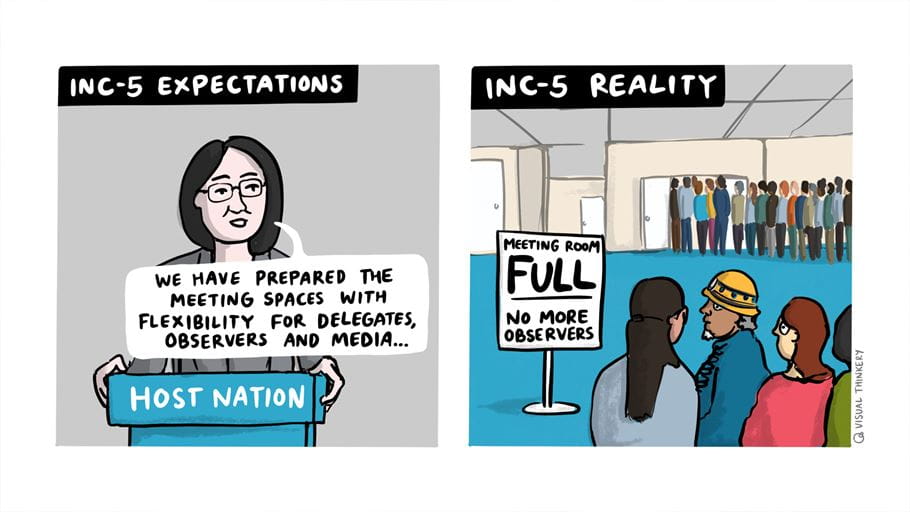
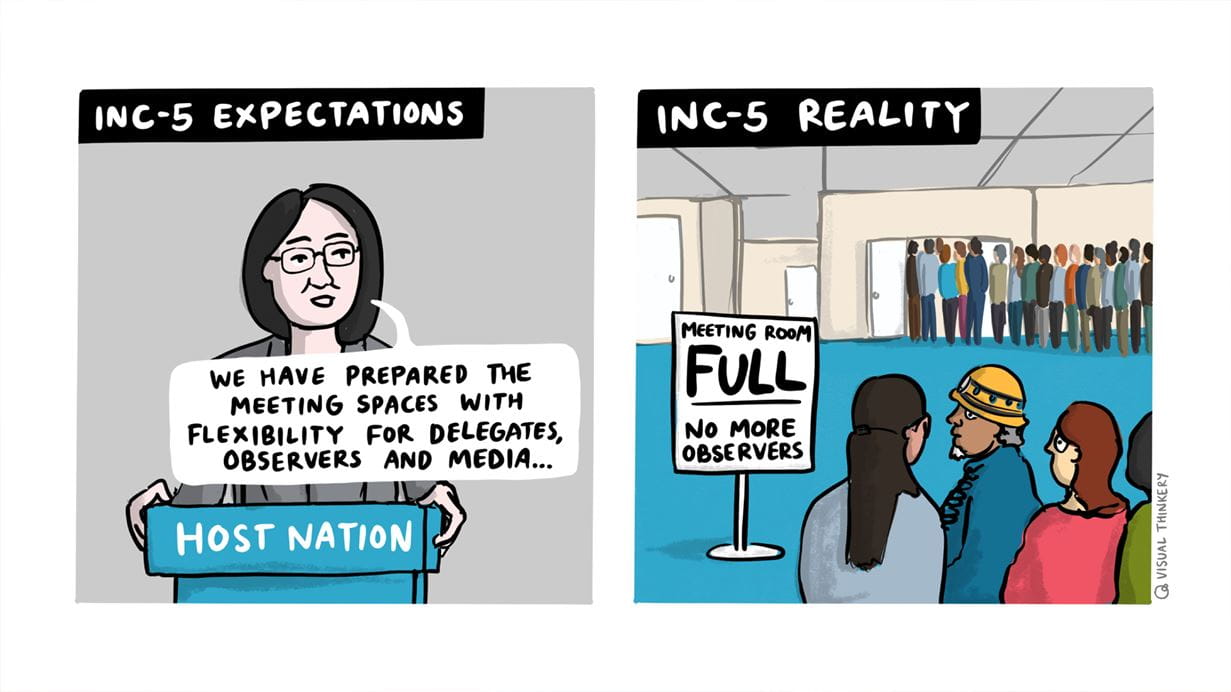
Despite the power of the hat, many NGOs and rights-holder groups, such as waste pickers, were left frustrated. ‘Closed door’ negotiations in the second half of the week shut observers out of the talks for several days. Earlier in the week, poor planning also left many groups struggling to access even the ‘open door’ negotiations.

A cartoon comparing expectations and reality for INC-5. On the left, the expectation is a person saying, ‘We have prepared the meeting spaces with flexibility for delegates, observers and media.’ On the right, however, the reality is a queue of people excluded from a full meeting room with a ‘no more observers’ sign outside.

Despite assurances from the host nation in advance of INC-5, access to negotiations was a major challenge for observers. Credit: Break Free from Plastic/Visual Thinkery

Even in the face of these challenges, our team had a real impact at the negotiations, working directly with delegations and allies to influence the direction of the treaty. We were pleased to have the opportunity, once again, to work with the delegation from the International Alliance of Waste Pickers (IAWP), supporting and amplifying their voices in the talks. We joined them to analyse each new version of the treaty text and to plan their responses and recommendations.

‘It is crucial that the voice of waste pickers is heard in these negotiations.’

The 20 million waste pickers worldwide play a vital role in tackling the problem of plastic waste. The voice of waste pickers must be heard in these negotiations if the treaty is to bring about the fair, equitable and inclusive transition they need.

As it stands at the end of INC-5, the draft treaty text includes crucial wording requiring countries to promote and facilitate a just transition (moving to a sustainable economy in a way that is as fair and inclusive as possible for everyone concerned) and to take into account and engage with waste pickers. Meanwhile, on waste management, we were very pleased that the key elements we have been lobbying for – such as preventing open dumping and burning – also remain in the text, despite attempts to remove them.

Hope in the face of disappointment

Late on Sunday night (or rather, early on Monday morning), delegates agreed to suspend the session and reconvene in 2025. The draft text remains riddled with brackets and, at the insistence of a small number of countries, the Chair was forced to admit that everything is still up for negotiation.

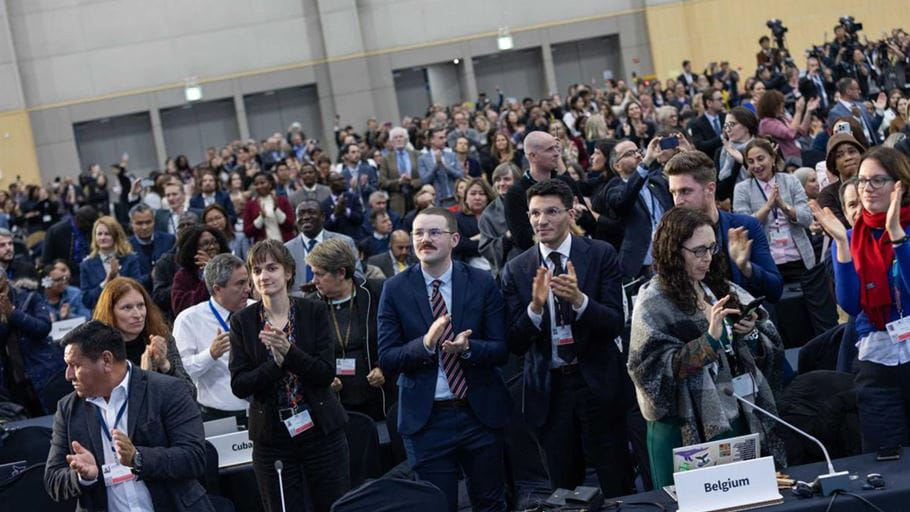
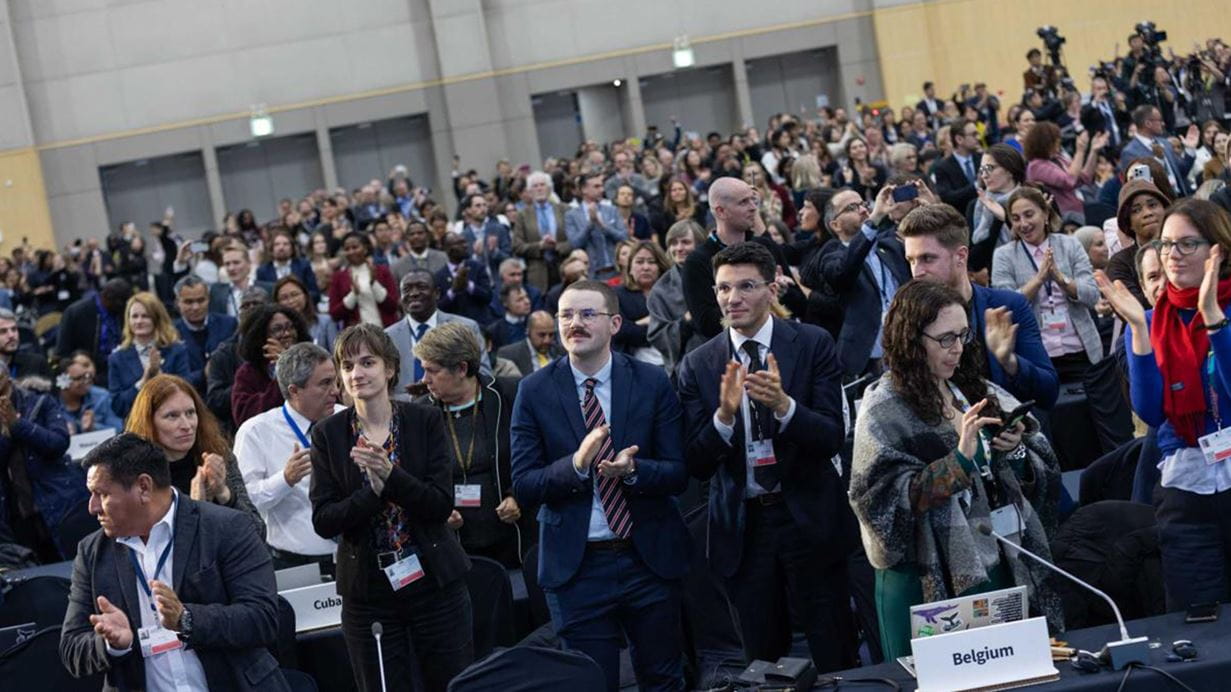
But as the week’s talks came to an end, the stand-out moment of the final session was one of incredible hope and unity. Delegates and observers alike responded en masse to Juliet Kabera of Rwanda’s call, on behalf of 85 countries, to ‘stand up for ambition’. For more than a minute, the vast majority of delegates stood, cheered and applauded in what one observer described as 'a powerful and emotional expression of the will of the majority’.

Later, Camila Zepeda of Mexico read a Declaration on Plastic Products and Chemicals of Concern on behalf of 94 countries. It stated that the text must contain a clear, legally binding obligation to phase out the most harmful plastic products and chemicals of concern in plastics. This was again met by cheers and applause. It is hoped that this energy and determination will carry through to INC 5.2 (date and venue to be confirmed).

Hundreds of people of different nationalities stand to applaud a call to ‘stand up for ambition’.

Delegates respond to Juliet Kabera’s call to ‘stand up for ambition’. Credit: IISD/ENB, Kiara Worth

An ambitious plastics treaty is still possible

Opinions are divided on whether INC-5 can be classed as a success. By the end of December, four major multilateral talks had ended in relative failure in the space of just two months. This has led some to question whether the UN system is fit for purpose. But there is much wisdom in former Irish President Mary Robinson’s comment that ‘the UN system is the worst system except for all the others.’

The decision to continue negotiations means a strong, ambitious, legally binding treaty that secures justice for the world’s poorest communities is still possible and we are continuing to fight for that!

Please continue to pray that we can influence the negotiations, in partnership with the IAWP and others, to secure the result that’s needed to bring about an end to plastic pollution and its devastating impacts on people living in poverty. Thank you.

Written by

Written by  Lucy Tanner

Lucy Tanner is a Senior Associate in Tearfund’s Public Policy Team

Share this page

Share this page to spread the word and help support those in need.

Get our email updates

Learn about our work and stay in touch with Tearfund. Hear about our news, activities and appeals by email.

Sign up now - Get our email updates